
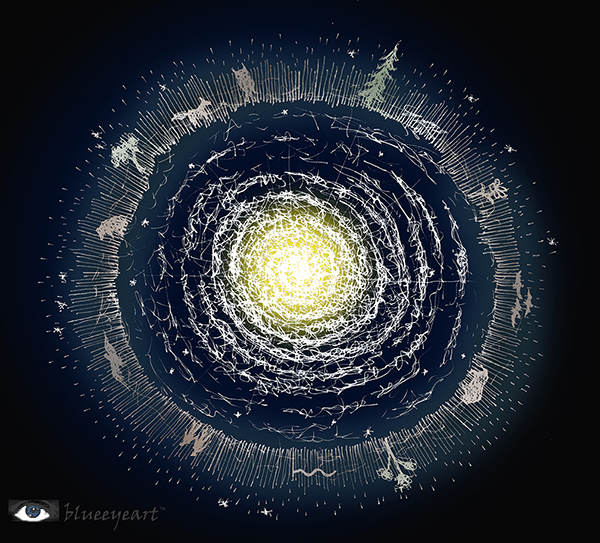
Imagination
The drum beat and the dimming of the lights are tools for journey work, as are a quiet room and a focused mind. One of the most important tools, however, is your imagination. For some, this comes more easily than for others, but with practice, it becomes a crucial part of the journey.[1]
Understanding the Role of Imagination
Many people are taught to see imagination as a childish escape from reality, or even as a form of lying. But in spiritual work, it’s a profound and necessary faculty. Think of it as a bridge, a direct line to the subconscious mind and the unseen realms. It’s the language of the soul.
Instead of a tool for creating fiction, imagination becomes a tool for reception. You aren’t inventing what you see; you are simply tuning in to it. The drumbeat and the intention you set are like focusing a camera lens. Your imagination is the film that captures what’s revealed.
The key is to shift from trying to control what you imagine to allowing it to unfold. This is where the concept of “letting go” is so important. You are a witness to the images, sounds, and feelings that arise, rather than the director of the experience.
Your Guided Journey: A Call to Action
The journey is a personal, intimate process. This is a framework you can use to make the most of your journey-work.
1. Preparation
First, set the space. This is how you signal to your mind and body that it’s time to shift from the ordinary world into the journey space. As you settle in, find a comfortable position and begin to sink into a meditative state.
2. Setting Intention
Next, narrow your intention. This is the heart of your journey. Define your intention with a short phrase or a mental image that is easily “held” in your awareness. Place it in your heart space. Your intention is not a goal to be achieved, but a question to be explored. For example, instead of “I want to be healed,” your intention could be “What wisdom do I need to help me heal?”
3. The Gateway
Now, imagine a comfortable starting place. This may be somewhere you have been or somewhere you’d like to visit that radiates comfort, safety, and connection. It could also be an emotional place or the feeling of being with a loved one.
From here, look for an opening that invites you to proceed. It could be a hole in the ground, a doorway, or even a pool inviting you to dive in. Enter the opening. This is a clear transition from the physical world into the imaginal one.
4. Following the Thread
Once you’ve entered the opening, let go of trying to direct where you are going. Let your imagination and discernment pull you forward. The intention in your heart will whisper to your imagination; you don’t need to interfere.
Think of this journey as a series of forks in the road. In the beginning, each direction is a mere flip of a coin. For example, there’s a pink road to the right and a blue road to the left. Breathe, close your eyes, and take a step. Then another. Open your eyes to find you’ve taken the pink road. Or, you might see five past friends who are here to offer guidance. Breathe, close your eyes, and without thinking, step up to one and follow them.
The idea is to follow this imaginary storyline quickly and without thought. It can become quite fantastical and magical, and that is as it should be. The fantastical elements, like talking animals or magical landscapes, aren’t random. They are the language of the unconscious, and they hold the wisdom you’re seeking.
By framing imagination this way—as a receptive tool that speaks in symbols and images—you empower yourself to have a deeper, more meaningful spiritual experience. The journey is not about what you create, but about what you discover.
—————
This Foundations of Shamanic Practice teaching is provided in whole or in part by the Shamanic Community of Austin, Blue Eye Art, and the Shamanic Passages Institute. Please join us in-person or virtually for a shamanic journey experience by RSVPing on our Meetup site.
[1] Illustration by Nate Long “Owl” titled On this Longest of Days. Found at https://blueeyeart.com/on-this-longest-of-days/